Lest we forget
A post about Talk Talk

‘Technique has never been an important thing to me. Feeling always has been, and always will be, above technique.’ – Mark Hollis
Playing in Gravenhurst in the late 2000s was an incredible musical education. Learning Nick Talbot’s beautiful songs and playing alongside him was an inspiration in itself – but he also introduced me to music that, to paraphrase Bruce Springsteen’s line about hearing ‘Like a Rolling Stone’ for the first time, kicked open the door to my mind.
I already listened to what I thought was a fairly wide range of music, but some of the things Nick played me didn’t seem to fit into the categories I knew. I remember listening to one of Nick’s mix CDs in the van and asking, ‘What genre is all this?’ The music wasn't obscure, exactly, but under Nick’s curation, disparate songs seemed to share the same mysterious aesthetic. It was like an underground river flowing beneath whatever music was trendy or popular at the time. Nick’s answer was ‘psycho-tropicália’, and that’s as good a description as any. There were things that had fallen out of fashion, like shoegaze (Slowdive’s long-delayed reappraisal was still a long way off), but there was also dance music, post-punk, and unlikely singer-songwriters. I guess you might not expect Nick Talbot to have been a big fan of Suzanne Vega, but he definitely was. He often quoted something she said about songwriting (which I’m struggling to find online, so maybe we should just start attributing it to Nick): resist the temptation to use too many chords because all the world’s mystery is contained in E minor. Which reminds me, there’s a great Magritte quote which Nick was also fond of: ‘People who look for symbolic meanings fail to grasp the inherent poetry and mystery of the image.’ I can hear Nick saying that, valuing mystery for its own sake. And I can still hear him singing along in the van to ‘Who Loves the Sun’ by the Velvet Underground, or ‘Dead Set on Destruction’ by Hüsker Dü, the latter rendered strange and eerie by the choirboy clarity of his voice.
In an interview Nick once said of Ian Curtis, ‘he didn’t seem to be talking about this world, but one that existed alongside it’. Whether it was Future Sounds of London’s ‘Papua New Guinea’ or a track off Fugazi’s Steady Diet of Nothing, it felt like all the music on Nick’s mix CDs came from this parallel dimension.
But it was when Nick played me Scott Walker and Talk Talk that the door to my mind was kicked wide open. For a time, my friends – and the bands we played in and played with – all seemed to be listening to Scott 4 and Laughing Stock. Alex, the guitarist in Gravenhurst, and I would write daft texts to each other referencing ‘The Seventh Seal’ (‘Are you still mates with the minstrel filled with visions’ and so on).
I can remember sharing a hotel room with Nick, the only light the eerie green glow from his laptop, listening to ‘After the Flood’ by Talk Talk in silence, totally transported. To this day, if I ever have to wait ten minutes for a bus or a train, or I just want to take a little break away from work – or, better put, from reality – I listen to ‘After the Flood’. Ten minutes of transcendence.
Mark Hollis, the singer and co-founder of Talk Talk, died in February 2019, the day before my father. I remember taking a walk the day of Dad’s death and hearing a builder’s radio play ‘Life’s What You Make It’; a tribute to Hollis, that I felt as a tribute to my Dad. It was a strange moment, one that felt numinous and rich with meaning. If you’re grieving there’s a period where everything seems resonant – ‘the night alive with stars and signs I can’t explain’, as Nick once sang (borrowing from Camus). I was struck, hearing it then, by how different Hollis’s voice sounds from other pop singers. There’s a keening quality to those beautifully wavering toplines – something yearning and inscrutable. Even on ‘Life’s What You Make It’ or ‘It’s My Life’ you can hear the seeds of the extraordinary left turn Talk Talk would take later in their career (a dramatic progression from pop to experimentalism that was matched only by Scott Walker himself). Hearing that voice so incongruously in the street on that day was a moment that took me out of reality; a little message or token not from this world, but from one that exists alongside it.
Nowhere is Mark Hollis’s voice more beautiful and more devastating than on ‘After the Flood’. He sounds like Lear raging on the heath, his voice filled with pain and rapture. There’s a superb passage about the song in Rob Young’s Electric Eden: Unearthing Britain’s Visionary Music:
Laughing Stock is a brilliant achievement, building on the discoveries of Spirit of Eden but pushing towards hitherto unknown regions of fluidity, abstraction and hushed, tensed power. ‘After the Flood’ contains the masterstroke: with Lee Harris recreating the drum pattern of Can’s ‘Halleluwah’, Hollis torched the centre of the track with a one-note, overtone-heavy Variophon solo. This was a German invention, a synthesized wind instrument shaped like a clarinet, with a blow control designed to allow greater expressive possibilities. Hollis’s model was malfunctioning, and the deluge of noise he emits, lasting all of one minute fifteen seconds, jerks caustically between octaves, like a breaking voice bellowing in anguish. It is literally a purging flood of sound. Hollis stated that he visualised the jazz reeds player Roland Kirk, who was able to play two or three instruments at once in his mouth. ‘It’s one note, but you feel the note.’
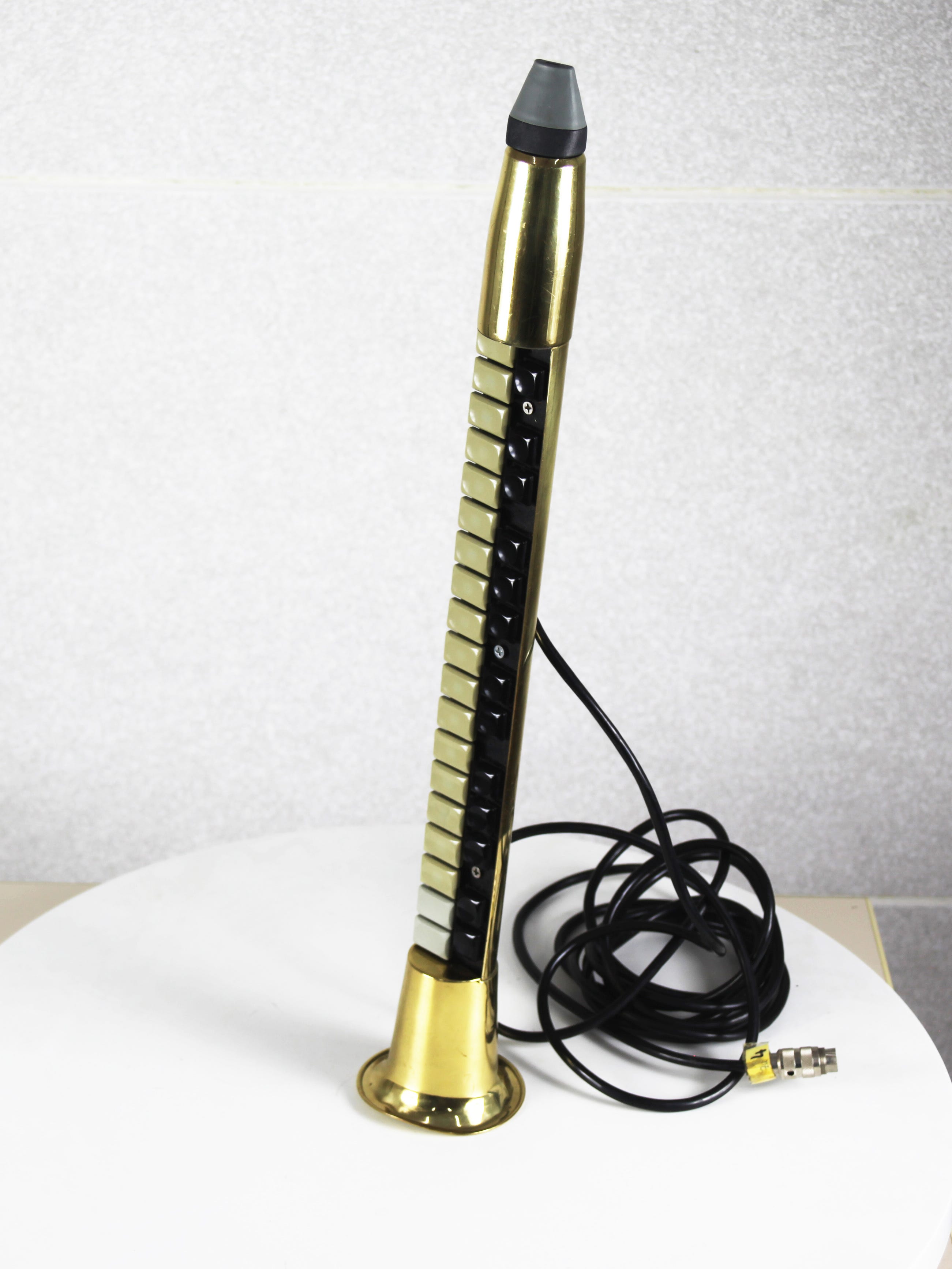
When I read this I had a bizarre realisation. I had listened to ‘After the Flood’ hundreds of times but never noticed that ‘deluge of sound’. Listening to it now, it’s extremely hard to miss. It’s not like something you become aware of once you’re told about it – like the cut between two takes on ‘Strawberry Fields Forever’ – it’s an incredibly clear minute-long stretch of screaming noise. Why hadn’t I ‘heard’ it?
Well, the answer is that I had, but unconsciously. I knew it as part of the fabric of the song. But the mood of that piece of music, its sonic universe, was so immersive, so self-contained, that I hadn’t really stopped to think about its different elements, its structure – verse, chorus… purging flood of sound. It was all just part of something I experienced in those ten minutes of transcendence.
And it made me think, what are we doing when we listen to music? We’re not concentrating with laser focus on every aspect of production or song structure while the song plays – we’re somewhere else. Where am I when I’m listening to ‘After the Flood’? Maybe I’m back in that hotel room with Nick, or maybe Hollis’s voice is taking me to that resonant street in Bristol with the builder’s radio.
The more I listen to ‘After the Flood’, and the more I try to pay attention to the song rather than ‘experience’ it, the more amazed I am by its profundity and its spiritual depth. Thankfully, further analysis doesn’t diminish the song’s mystery – it deepens it.
Lyrically, the song is difficult to decipher (mystery for mystery’s sake perhaps), although people have made valiant attempts to decode it online. There are clear Biblical allusions (the flood, the reference to Cain) – and the phrase ‘lest we forget’ is obviously freighted with meaning. Is it an apocalyptic vision of the atrocities of the 20th century? Perhaps, but the words resist easy interpretation – even the syntax is strangely warped. Does ‘dead to respect’ mean impervious to respect (as in ‘you’re dead to me’), or is it a distorted rephrasing of an instruction to ‘respect the dead’ (something like ‘there are the dead to respect’)? The song contains fragmentary lines that you can hear thousands of times and still be none the wiser: ‘spurning step by state’, ‘Cain in number’, ‘sleight of reason’ – add to this the near unintelligibility of Hollis’s delivery and it’s clear that conveying a direct meaning was never the intention.
Lyrically it may be unclear (and beautifully so), but musically ‘After the Flood’ makes a kind of sense, to me at least. Whenever I hear it, it sounds like the song is ‘about’ the juxtaposition between the everyday and the divine, the earthly and the spiritual.
The verse section is rooted around an unresolved, very open-ended F dominant 7th. Someone has done a good job of transcribing the song for guitar here, and you can see how harmonically dense those verses are; the transcriber has added F6s, Bbmaj7s, Bbmaj11s. The organ carries these chords, pedalling on that droning F, but the extensions are also accented with strange backwards-sounding loops and hints of guitar. The dubby bassline holds everything together, grounding the other instruments, but only loosely. The whole feel of the verse is of something inchoate, a wave waiting to break.
It’s in the chorus when Hollis sings ‘Shake my head’ that the floodgates open. Suddenly the song comes into focus. There are beautiful minor sevenths, and a three-chord pattern on the guitar (Gm7-Dm-F) that sounds like sunlight shining through stained glass.
The contrast between these two sections seems to me to be what the song is ‘about’ (if music itself can be said to be about anything). The verses are reality: unresolved, searching for meaning, grounded by the quotidian; the choruses are spirituality: the sense that there is something beyond what can be understood and described. And, naturally, that wild Variophon solo lasts for the duration of an entire verse section – the wild yearning, the ‘breaking voice bellowing in anguish’ – and fades out just as the chorus begins, signalling that we have left one state and entered another.
It’s a reminder of the possibility of transcendence, a glimpse of the spiritual dimension to our everyday lives. Sometimes a street is just a street and sometimes it’s a place of reverie, of meaning. Sometimes a bus stop is just somewhere where you wait for a bus, sometimes it’s a place to experience rapture. The broken Variophon solo of life fades out and we go somewhere else – back into the past, back into contact with the people we’ve lost.
While we’re on the subject of Talk Talk, this post from my friend James about the B-side to ‘Life’s What You Make It’ is really worth reading:

If you want to support this monthly Substack, or my music, or my podcast, please feel free to donate here:
God, I hope you write a book one day.
Thanks so much for this, Robin. This piece is, as your essays always are, a beautiful braiding of personal stories and experiences, a true celebration and deep understanding of the music itself, and a generous openness to meaning and significance.
This was a lovely way to start my day. Thank you for taking the time to put these thoughts down and for sharing them here.